
If you’re shipping more than a couple hundred orders a day, your returns pile stopped being a nuisance a while ago. It’s a line item now. And the question every operator eventually hits is whether your ecommerce returns solution should live inside your own four walls or get handed to a 3PL. We’ll give you the answer up front, then walk the math and the actual process so you can check it against your own numbers.
We run returns for DTC and Shopify brands all day, from sellers doing 200+ orders daily up to a brand at $70M a year. So this isn’t theory. It’s what we watch happen when the return rate climbs and the back room fills up.
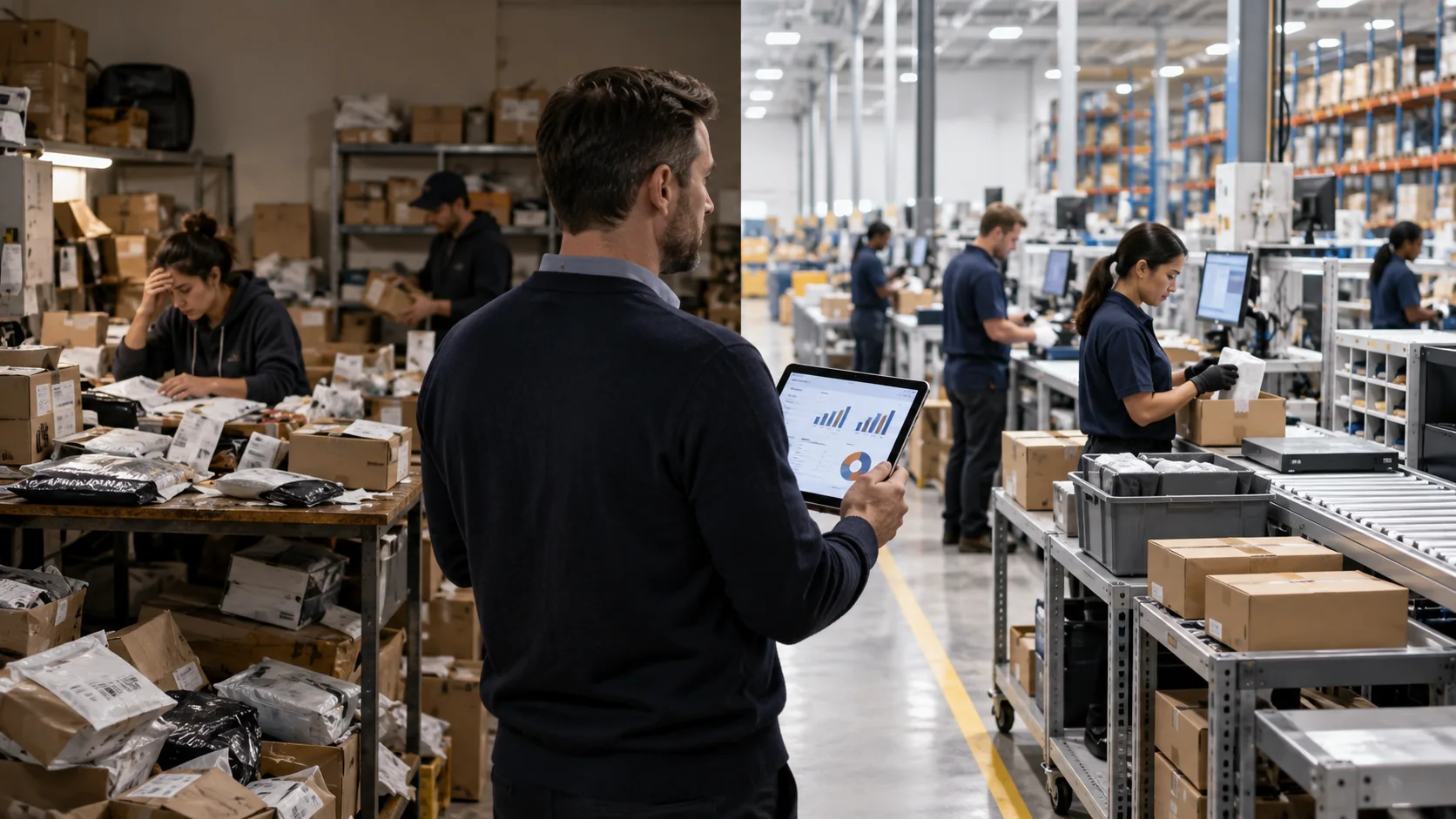
The short answer: outsource returns once you pass ~200 orders a day
Keep returns in-house while you’re under roughly 200 orders a day and your catalog stays simple. Past that, or the moment you start selling across borders, an outsourced ecommerce returns solution usually wins on cost per return and on cash recovered, because a 3PL already owns the warehouse space, the labor, and the inspection process that would otherwise sit half-idle between your peaks.
The tipping point isn’t only volume. It’s variability. A brand with steady, predictable returns can run a tight in-house desk for a long time. A brand with sharp seasonal spikes pays twice for in-house: once for the staff you need in Q4, and again for the same staff standing around in February. Outsourcing turns that fixed cost into a per-unit cost, which is what most growing sellers actually want.
What are the causes of ecommerce returns?
Most returns trace back to four things: sizing or fit that didn’t match the buyer’s expectation, an item that arrived different from the product page, damage in transit, and plain buyer’s remorse. Fit and expectation gaps dominate apparel and anything dimensional. Damage and description gaps point at your packaging and your listing, and those you can fix at the source.
That last point matters more than the return math itself. When we onboard a brand and see the same SKU coming back for the same reason, that’s a product or packaging problem wearing a returns costume. We push it upstream. One client cut return volume on a fragile line by changing to custom packaging with better inserts during a 45-day brand upgrade that also lifted AOV by 22%. Fewer returns is always cheaper than better returns.
Description-gap returns are the easiest to attack, because they’re free to fix. A rewritten spec, a photo that shows real scale, one line about how the thing actually fits. Do that before you spend a dollar processing the return that copy would have prevented.
What ecommerce returns processing actually involves
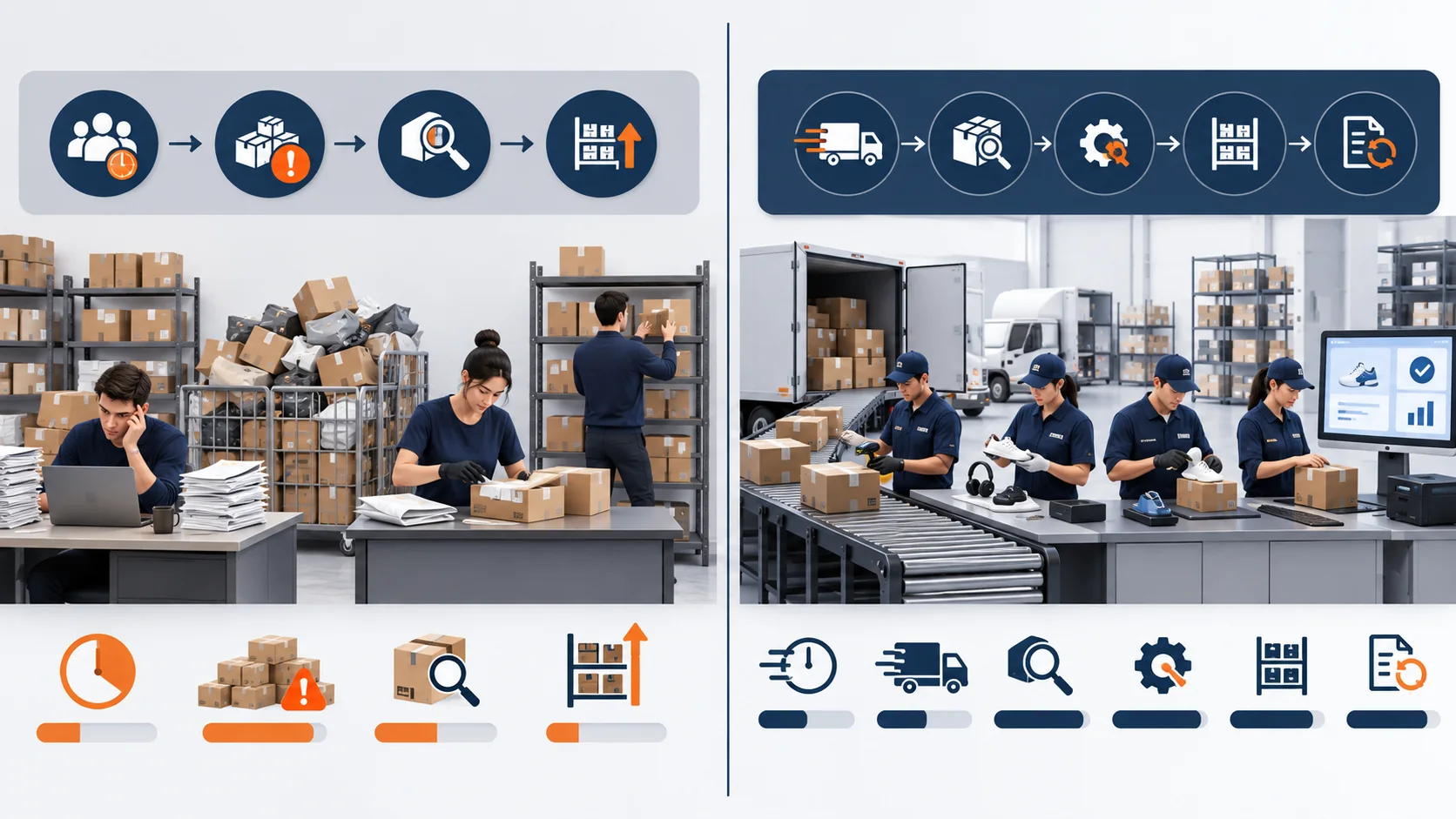
People underestimate this part. Ecommerce returns processing isn’t “open box, refund, restock.” A single return moves through six real steps, and each one costs time or money if you skip it.
First, the unit comes in and gets scanned against its return authorization, so you know it’s a real, approved return and not a random box. Second, it’s inspected and graded: is it new and sellable, lightly used, damaged, or dead. Third, based on that grade it’s routed to restock, refurbish, liquidation, or disposal. Fourth, the refund or exchange gets triggered against the right order. Fifth, inventory updates so a graded-A unit is instantly available to sell again. Sixth, the reason code gets logged so the data means something later.
The grading step is where in-house desks quietly lose money. Rush it, and you either restock damaged goods (angry second customer, second return) or trash sellable inventory (pure loss). A disciplined grade is the difference between recovering 70% of a return’s value and recovering 20%. We treat inspection at the returns bench with the same care as the pre-shipment inspection we run before goods ever leave, at $150–300 per batch on the outbound side, because catching condition problems early is the whole game on both ends.
How long should ecommerce returns processing take?
For domestic returns hitting one of our local warehouses, a graded and restocked turnaround inside 48 hours is a reasonable target, and refunds should fire the same day the unit is verified. Speed here isn’t cosmetic. Every day a return sits ungraded is a day that cash and that sellable unit are both frozen.
The real cost of keeping returns in-house
The sticker price of in-house returns looks low because most of it hides in labor you’re already paying. Then you add it up. You’re covering warehouse square footage for a returns bench, staff hours to inspect and re-bag, refund-processing time, and the write-off on anything mis-graded. During a peak, you’re paying overtime or temp labor exactly when your team is already buried in outbound.
The bigger, quieter cost is trapped cash. Returns you can’t grade fast are returns you can’t resell, so working capital sits in a pile of boxes. We rebuilt one client’s inventory model and pulled their stocking capital from $1M down to $600K by making stock and returns decisions on data instead of gut. A slow returns desk works directly against that kind of gain.
In-house does make sense in two cases. You’re still small and returns are simple, so a person handling them part-time is genuinely cheaper than any per-unit fee. Or your product is so specialized that grading requires your own team’s judgment. Outside those, the numbers usually drift toward outsourcing as you scale.
Ecommerce returns management outsourcing: what you gain and what you give up
Ecommerce returns management outsourcing swaps your fixed returns overhead for a per-return price, and it hands the labor spikes to someone whose whole business is absorbing them. You gain warehouse capacity you don’t have to lease, a trained grading process, and reach you’d struggle to build alone. Our network runs across China, the US, and Europe, so a US buyer’s return lands at a US facility instead of shipping back overseas at a loss.
That geography changes the economics of cross-border brands. Returns handled at an overseas warehouse near the customer get received and graded on local timelines, while a cross-border return route can eat 5–10 days and a chunk of the item’s value in freight before anyone even opens the box. Local processing on the outbound side already gives our brands 24-hour dispatch with 2–3 day last-mile delivery, and returns ride the same infrastructure in reverse. One client saved $1.2M by moving to a localized logistics strategy across their flows, returns included.
What do you give up? Direct hands-on control of each unit, and a little visibility unless your 3PL reports well. That’s a fair trade above a certain scale, but only if the partner sends you clean reason-code data back. Returns data you can’t see is returns data you can’t act on, and acting on it is how you shrink the return rate in the first place.
Cost comparison at a glance
| Factor | In-house returns | Outsourced returns solution |
|---|---|---|
| Cost structure | Mostly fixed (space, staff) | Per-return, scales with volume |
| Peak season | You pay for surge labor | Absorbed by the 3PL |
| Grading quality | Depends on your team’s time | Dedicated, trained bench |
| Cross-border returns | Slow, expensive freight home | Handled at a local warehouse |
| Cash recovery speed | Often slow, capital trapped | Fast grade, fast restock |
| Best fit | Under ~200 orders/day, simple SKUs | Growing volume, spiky demand, multi-region |
How to choose your ecommerce returns solution
Start with your own return rate and where the returns come from. If you’re domestic-only, low volume, and returns are steady, keep it in-house and put your energy into the causes above. If you’re crossing borders, spiking seasonally, or watching your team drown every Q4, price out ecommerce returns management outsourcing and compare it honestly against your loaded in-house cost, not just the sticker.
When you do compare, ask the 3PL three concrete things: how they grade and route returns, how fast a graded-A unit goes back to sellable, and what returns data they hand back. If any of those answers are vague, keep looking. You can see how we structure returns inside our returns management service, and how it connects to the rest of the flow through our ecommerce fulfillment network. When you want real numbers against your own volume, our pricing page is the place to start.
FAQ
At what order volume should I outsource ecommerce returns?
Roughly 200 orders a day is the point where most brands find outsourcing pays off, but variability matters as much as raw volume. If your returns spike hard in peak season, outsourcing can win earlier because you stop paying for surge labor that sits idle the rest of the year.
How does outsourced ecommerce returns processing handle refunds?
The 3PL scans each return against its authorization, inspects and grades condition, then triggers the refund or exchange against the original order once the unit is verified. Good partners fire domestic refunds the same day they verify, and update inventory immediately so graded-A units go straight back to sellable.
Can outsourcing returns actually lower my return rate?
Yes, indirectly, and it’s the part sellers miss. A returns partner that logs clean reason codes shows you which SKUs come back and why, so you can fix the sizing chart, the packaging, or the product page. Attacking the causes is what shrinks the rate. The processing just handles what’s already coming.