
Most sellers picture a third party logistics warehouse as a big room full of shelves. It’s a lot more than that. What happens between a truck backing into a dock and a customer opening a box is a chain of small, unglamorous decisions, and any one of them can wreck your delivery promise. If you’re a DTC or Shopify brand pushing past 200 orders a day, the inside of that building is where your margin either holds or leaks away.
We run this every day for brands ranging from early-stage stores up to a $70M account, so let’s walk the floor. Not the sales-brochure version. The real one.
What Is a Third-Party Logistics Warehouse?
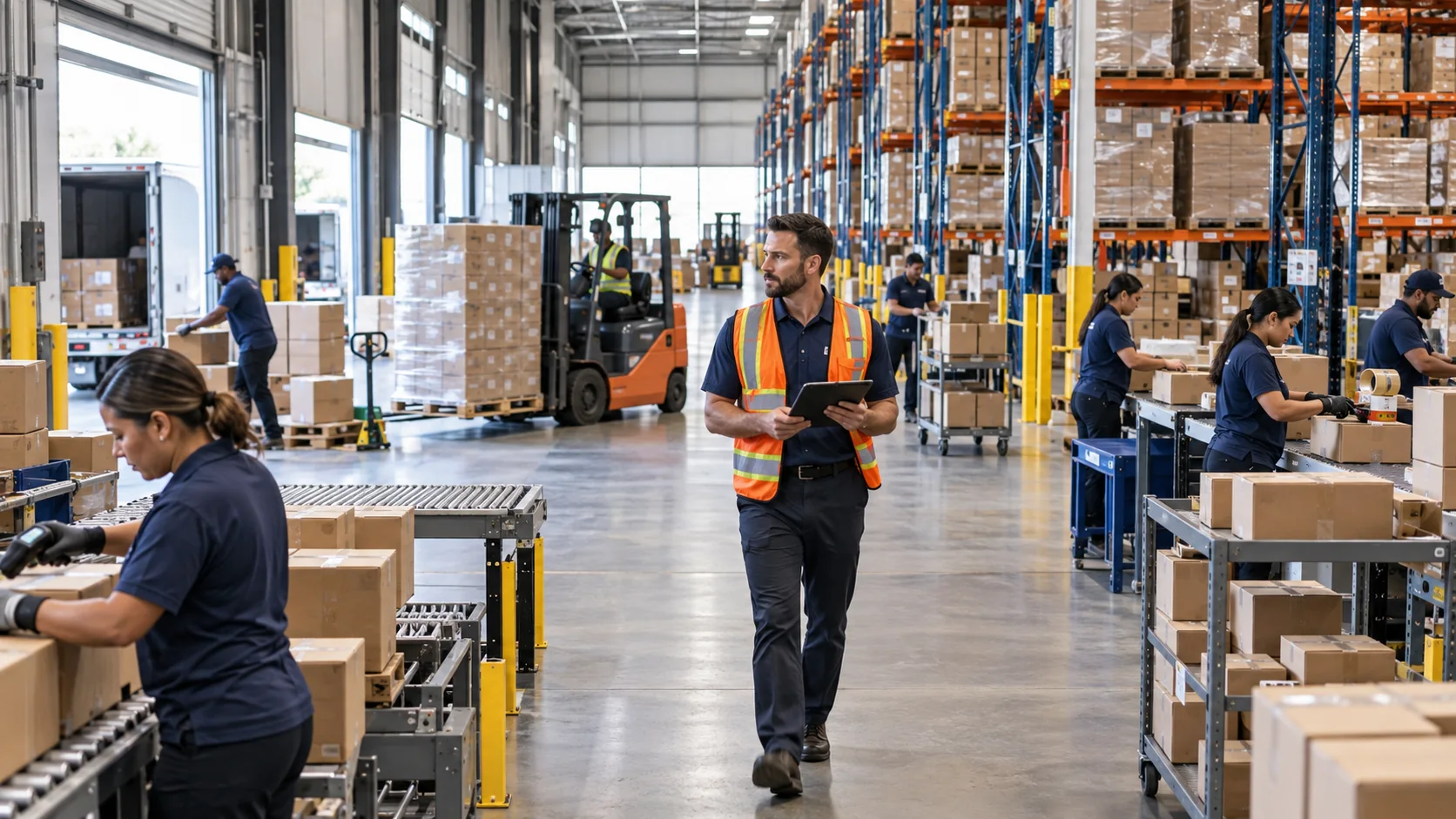
A third party logistics warehouse is a facility run by an outside provider that stores your inventory and handles the physical work of getting orders to customers. You ship product in, the provider receives it, stores it, and then picks, packs, and dispatches each order as it comes through. You keep selling. They handle the boxes.
That’s the short answer. The longer one is where it gets interesting, because “storage plus shipping” hides four or five separate operations, each with its own failure points. Miss on receiving and the errors follow the product for weeks. Slot inventory badly and your pickers walk miles they didn’t need to.
If you want a fuller picture of the physical space itself, our team wrote up what a working 3PL fulfillment warehouse actually looks like inside. Here we’re going to follow a single unit of inventory through the whole cycle.
Receiving: Where Every Order Starts
Receiving is the least talked-about step and the one that quietly decides your accuracy for the next month. When a container or carton arrives, the team counts it against the ASN (the advance notice of what’s supposed to be inside), checks condition, and logs everything into the warehouse management system before a single item hits a shelf.
Skip the count, or rush it, and you inherit a phantom inventory number. Your store says 40 units. The shelf holds 34. Six customers get an oversell email they’ll remember.
This is also where quality gets caught early. For brands importing from overseas, we build a pre-shipment inspection into the flow before goods ever leave the origin, usually $150 to $300 per batch, so defects don’t travel halfway around the world before anyone notices. Catching a bad print run at the factory is cheap. Catching it at the point of a customer complaint is not.
Putaway and Slotting: The Part Nobody Sees
Once product is received, it has to go somewhere. Putaway sounds trivial, but where you put a SKU determines how fast it moves for the rest of its life in the building.
Good slotting puts your fast movers near the pack stations and your slow movers up high or in the back. It groups items that ship together. And it adjusts as demand shifts, because the bestseller in March isn’t the bestseller in November. A warehouse that slots once and forgets is one where pickers walk for a living.
Slotting ties directly into how much cash you have parked on the floor. We once worked with a brand carrying way more safety stock than it needed simply because nobody trusted the numbers. After we rebuilt their demand model and tightened the inventory data, they cut working capital tied up in stock from $1 million down to $600,000. Same service level. Same fill rate. $400K back in the business. That’s what clean warehouse data buys you.
Picking and Packing: How Orders Get Out the Door
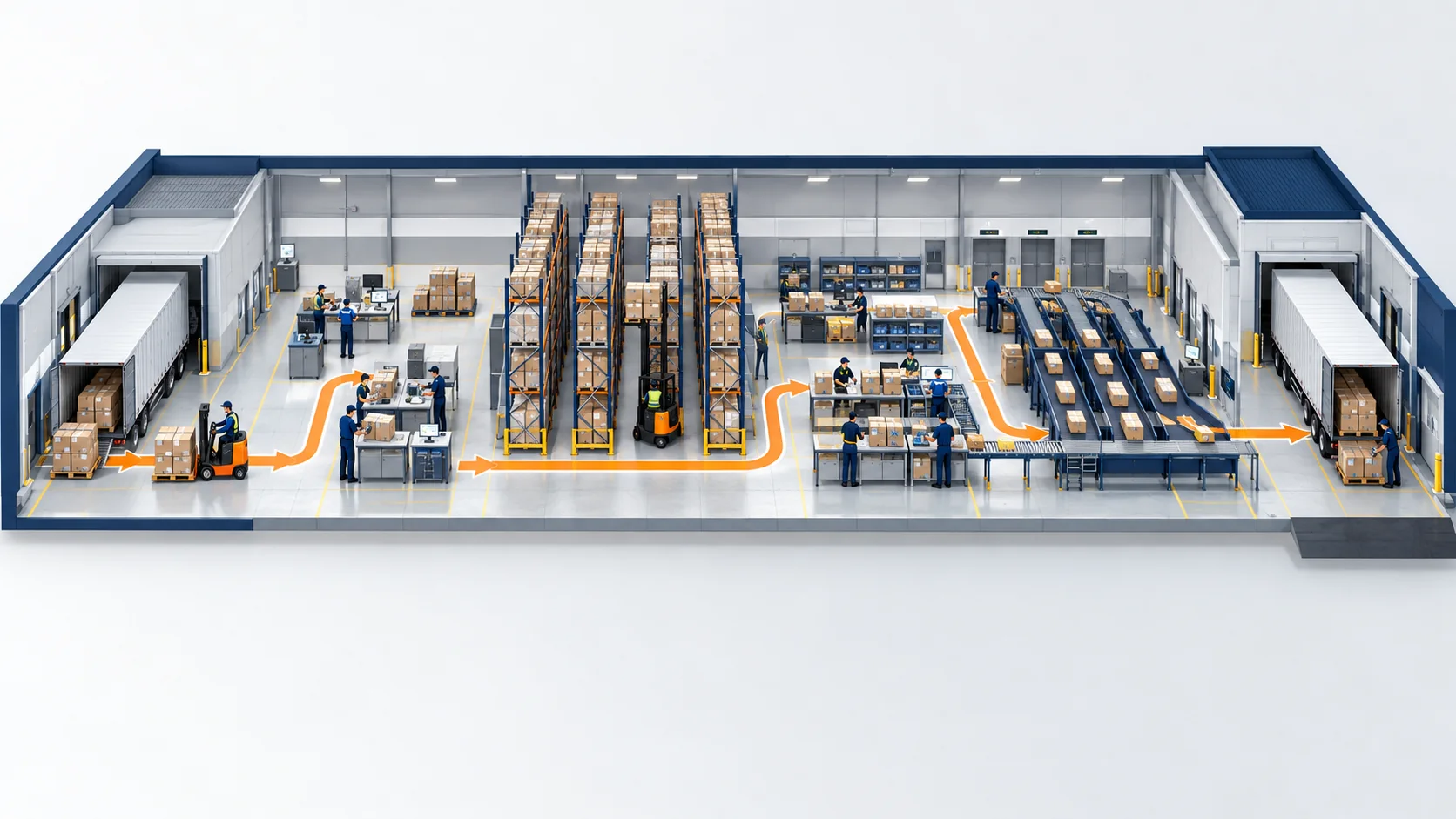
Here’s the part that maps to your customer’s experience. An order drops, the WMS generates a pick task, and someone (or a batch of someones) walks the route to collect the items. Then those items hit a pack station.
Picking strategy scales with volume:
- Single-order picking works when volume is low and you want simplicity.
- Batch picking groups many orders into one walk, then sorts them at pack-out, which is where most growing DTC brands land.
- Zone picking splits the warehouse into areas with dedicated pickers, handing off between zones for large or fast-moving catalogs.
Packing is where the brand experience lives. This is the moment to do more than drop product in a poly mailer. One client came to us with plain shipping and a flat repeat rate. In 45 days we rolled out custom packaging, printed inserts, a gift card, and branded mailers as part of the pack process. Their average order value climbed 22%. The pick didn’t change. The unboxing did.
If you want the mechanics of how an order actually leaves the building after packing, we broke down how the overseas warehouse outbound process works step by step.
How Do Multiple 3PL Warehouses Work Together?
Multiple warehouses work together through one shared inventory system that routes each order to the closest location with stock. You hold product in several regions, the system picks the origin that gets the package to the customer fastest and cheapest, and inventory levels sync across all sites so you’re never selling something that isn’t really there.
This is where a third party logistics warehouse stops being a single building and becomes a network. We run nodes across China, the US, and Europe, and the routing logic is the whole point. A customer in Texas shouldn’t get their order shipped from Shenzhen if the same SKU is sitting in a US facility.
The timing difference is stark. When an order can ship from local stock, we’re looking at dispatch within 24 hours and last-mile delivery in 2 to 3 days. Cross-border direct from origin runs 5 to 10 days. Neither is wrong. But knowing which one applies to which order, and pre-positioning inventory so more orders qualify for the fast lane, is the difference between a two-day promise you can keep and one you can’t.
Getting that split right saved one brand roughly $1.2 million by rebalancing where inventory sat versus where demand actually was. You can dig into how we structure regional coverage on our global warehousing services page.
What’s the Difference Between Warehousing and Fulfillment?
Warehousing is storage. Fulfillment is action. Warehousing is the space and the systems that hold your inventory safely and accurately. Third party logistics fulfillment is everything that happens the moment an order comes in: the pick, the pack, the label, the handoff to the carrier.
You can’t have good fulfillment without good warehousing underneath it. Sloppy receiving and bad slotting will sink even the fastest pack team. But warehousing alone, without a tight fulfillment layer on top, is just an expensive storage unit. The two have to work as one operation, run off one system, measured against one set of numbers.
That’s why we don’t treat them as separate products. A brand shipping 200 orders a day doesn’t care where storage ends and fulfillment begins. They care whether the box shows up correct and on time.
Choosing a 3PL Fulfillment Partner in the USA
If you’re evaluating 3PL fulfillment in the USA specifically, a few things matter more than the headline per-order price.
Ask where their inventory accuracy sits and how they measure it. Ask how they handle receiving discrepancies, because that number tells you how many oversells you’ll face. Ask whether pricing is factory-direct with no hidden markup or finder fee buried in the storage line. And ask about payment structure early; we work on flexible payment terms and flexible MOQs rather than rigid minimums, because a growing brand’s cash flow doesn’t sit still.
One more thing sellers underrate: sourcing. A warehouse that only stores what you send it is limited. We’ve taken brands from zero, helping with factory sourcing, product development, ad and creator guidance, and payment setup, then built the fulfillment around it. One went from launch to a sleep-wellness product line built entirely on that foundation. When your storage partner also understands your supply chain, the whole thing gets tighter. On that account, cutting the middlemen and going factory-direct pulled procurement cost down 18% inside 90 days.
Want a fast read on landed cost before you commit? Our instant quote tool takes a product photo and returns display pricing for one, two, or three pieces in seconds.
FAQ
How much does a third party logistics warehouse cost?
Costs usually break into receiving, storage (charged by space or by unit over time), and per-order pick-and-pack. The honest answer is it depends on your SKU count, order volume, and how fast product turns. Watch for hidden markups and finder fees folded into storage lines. We price factory-direct so you see the real number, and we work on flexible payment terms as you scale.
How fast can a 3PL warehouse ship my orders?
From local stock, expect dispatch within 24 hours and last-mile delivery in 2 to 3 days. Cross-border direct from an origin warehouse runs 5 to 10 days. The trick is pre-positioning inventory near your customers so more orders ship from the fast, local node instead of traveling across an ocean.
Do I need multiple warehouses or just one?
Start with one if your orders cluster in a single region. Add nodes when a meaningful share of demand sits far from your stock and shipping cost or transit time starts hurting conversion. Splitting inventory across regions only pays off when the routing and inventory sync are tight enough to keep every location’s numbers honest.