
If you’re running a Shopify store past 200 orders a day, shopify warehouse management stops being a settings-page task and turns into an operations problem. The native tools track stock and split it across locations. They won’t tell a picker which bin to grab, they won’t batch orders by carrier, and they won’t stop an oversell when two channels pull from the same shelf at once. We’ve onboarded DTC brands at exactly this stage, from first-time 200-a-day sellers up to a $70M label, and the wall shows up in the same place every time.
This guide covers the two paths you actually have. Keep fulfillment in-house, or hand it to a 3PL. Where each one works, where each one breaks, and how to set up the switch without wrecking your ship times.
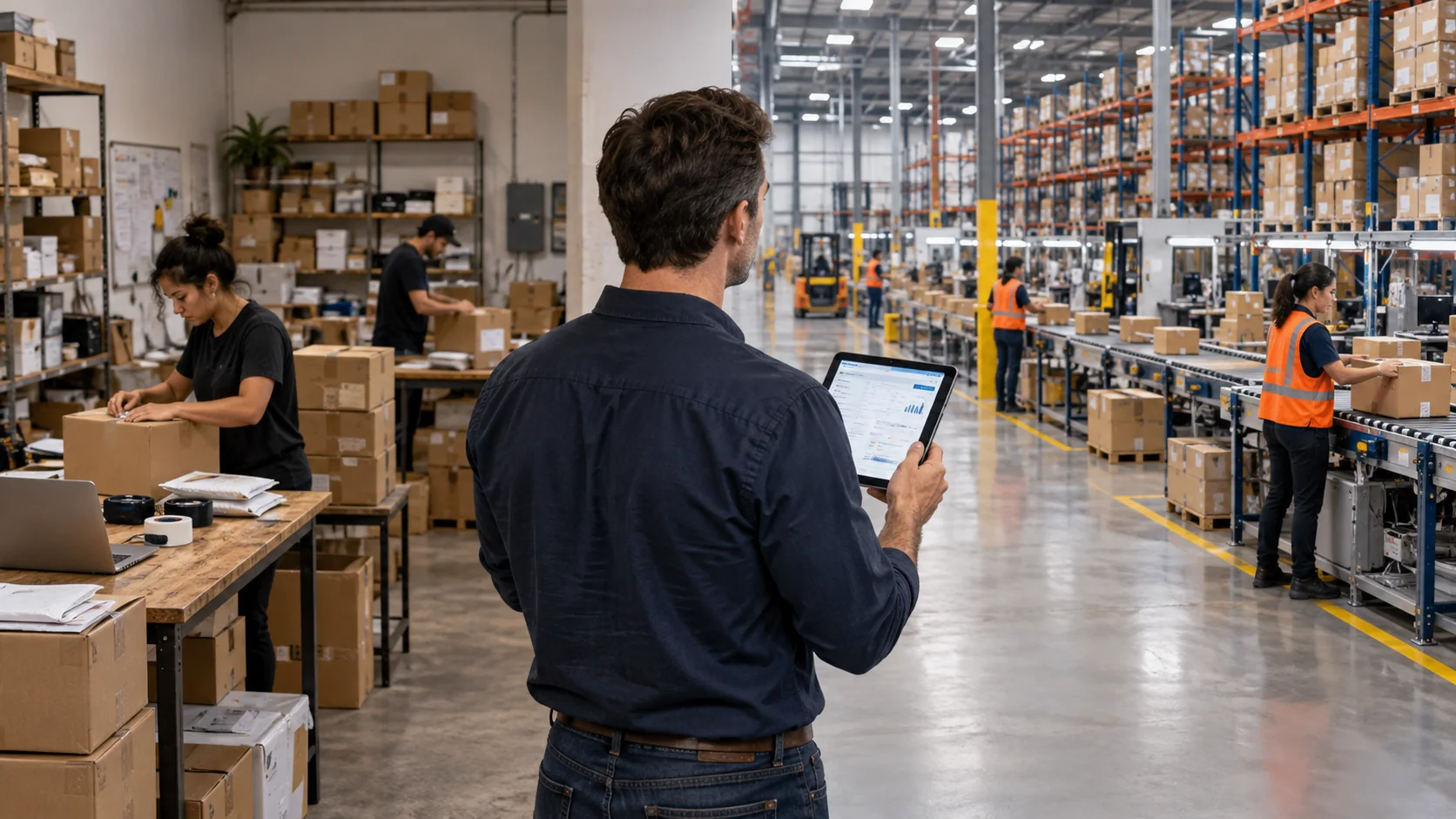
Shopify Warehouse Management: What the Native Tools Actually Cover
Shopify warehouse management, out of the box, means multi-location inventory. You assign stock to locations and set a fulfillment priority, then Shopify routes each order to the nearest location that has the item. It covers stock counts, low-stock alerts, transfers between locations, and basic reorder reminders. What it leaves out: bin-level picking, wave and batch picking, and barcode scanning at the shelf.
That gap matters more than the feature list makes it look. Shopify treats a “location” as a bucket of quantity. A warehouse floor is a physical map. Once your daily volume means two pickers could reach for the same unit, or one SKU lives in four spots across a big room, the bucket model starts costing you mis-picks and returns. Native inventory is fine for a garage and a couple of retail doors. It was never built to run a pick line.
Where Shopify’s Built-In Inventory Hits a Wall
A few failure points tend to show up together once orders climb:
- Overselling across channels. Shopify syncs quantity, not intent. If your TikTok Shop, Amazon, and Shopify checkout all draw from the same location, a spike can sell the same last unit twice before the counts settle.
- No pick path. There’s no walking route, no zone logic, no scan-to-confirm. Accuracy depends on people remembering shelf spots.
- Manual carrier logic. Choosing the cheapest service per weight and zone is on you or an app, not the core platform.
- Batch ceilings at peak. Printing and packing 800 orders on a Monday with the native flow means a lot of clicking, and a lot of room for a wrong label.
None of this means Shopify is broken. It means the platform assumes something else does the warehouse part once you scale. That “something else” is either a warehouse system you run, or a fulfillment partner who already runs one.
In-House Warehouse vs Shopify 3PL Fulfillment: The Real Trade-offs
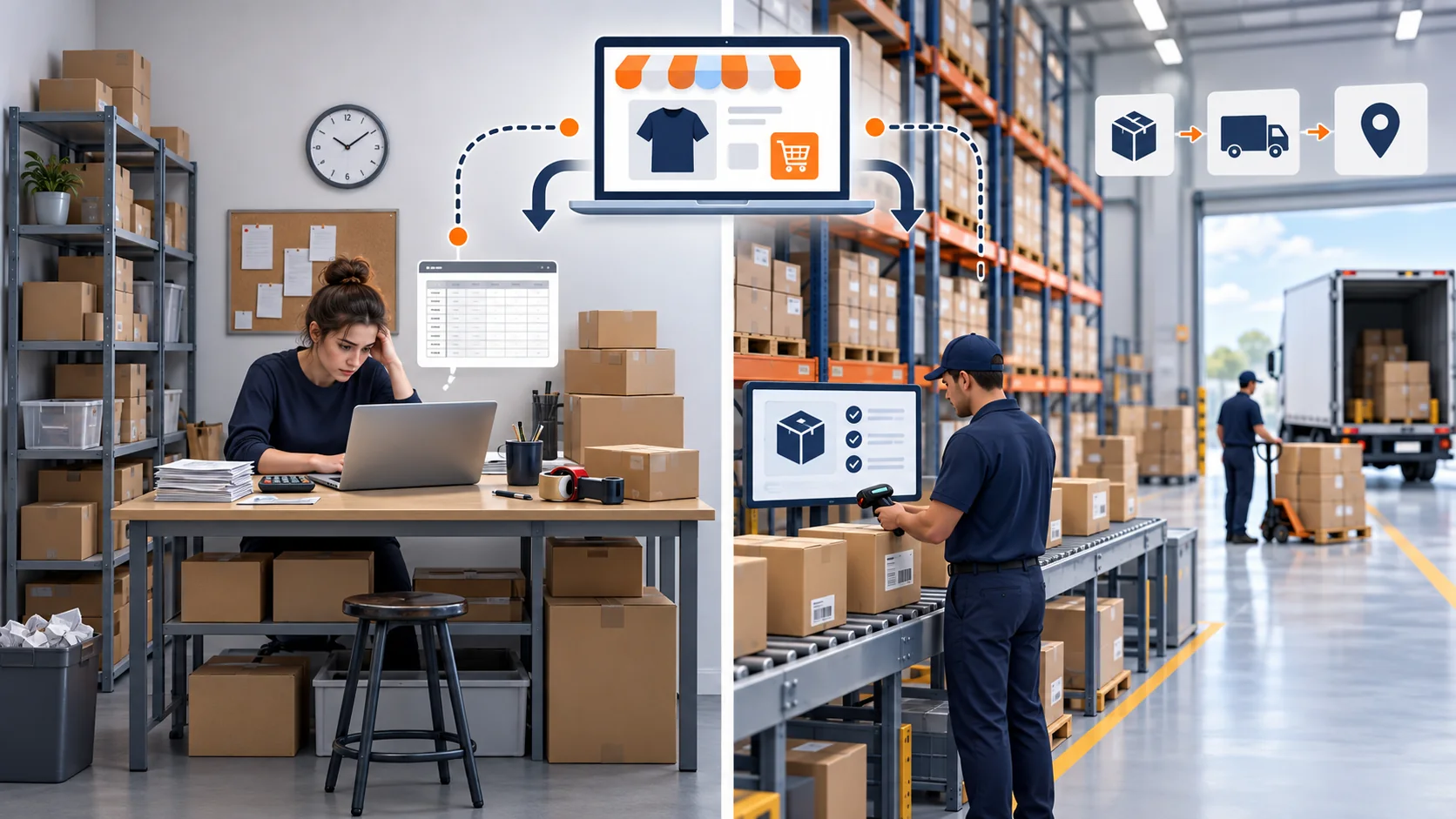
Here’s the honest split. In-house gives you control and eats your cash and attention. A 3PL trades some control for capacity you don’t have to build.
| Factor | In-house warehouse | Shopify 3PL fulfillment |
|---|---|---|
| Upfront cost | Lease, racking, WMS, labor | None; you pay per order and storage |
| Peak flexibility | You hire and lay off | Partner absorbs the swing |
| Software | You buy and maintain a WMS | Included, already Shopify-connected |
| International reach | One country unless you build more | Multi-region from day one |
| Break-even volume | Better past very high, steady volume | Better from 200/day up through mid-scale |
| Control | Full | Shared, with SLAs |
The part sellers underestimate is the money tied up before a single order ships. In-house means racking and a lease and a warehouse crew standing by whether you did 150 orders or 600 that day. One brand we worked with was sitting on $1M in stocking capital because they bought deep to feel safe. We rebuilt their reorder points against real sell-through and pulled that down to $600K, with no stockouts on their movers. That $400K went back into ads.
3PL flips the math. Our warehouse network runs across China, the US, and Europe, so a US buyer’s order ships from a US shelf while your cross-border restock is still in transit. That regional split is where our ecommerce fulfillment service earns its keep, and it’s the same reason one client’s move to a localized logistics setup saved $1.2M against shipping everything direct from origin. Speed and cost, same decision.
When Should You Move From In-House to a 3PL?
Move when fulfillment starts stealing hours from growth. In practice that’s around a steady 200+ orders a day, or the first peak where you’re packing past midnight, or the moment you want a second country and don’t want to sign a second lease. If shipping is now the job instead of a task, it’s time.
Two signals we tell sellers to watch for. First, your ship-time promise is slipping on normal days, not just peaks. Second, you’re saying no to a channel or a market because you can’t physically fulfill it. Both mean the warehouse is now the ceiling on the business, and building more of it yourself is slower and riskier than plugging into global warehousing that already spans three regions.
How to Set Up Shopify Warehouse Management With a 3PL
Switching well is a sequence, not a flip of a switch. Here’s the order that keeps ship times intact.
1. Profile your orders before you talk to anyone. Pull 90 days of order data: SKU velocity, average units per order, and where your buyers actually are. This tells you the domestic-versus-cross-border stock split and stops you overpaying for the wrong footprint.
2. Decide your stock geography. For a US-heavy store, forward-position your top movers in a US warehouse so local orders ship in 24 hours with 2–3 day last-mile delivery. Keep the long tail on a cross-border direct route, which runs 5–10 days. Don’t blend those two numbers in your shipping promises; they’re different lanes.
3. Get a real cost read early. Send product photos through our instant quote tool and you’ll get 1/2/3-unit pricing back in seconds, so you can model landed cost per order before committing. Treat those as display prices for planning, then confirm the full per-order rate against your profile.
4. Connect the 3PL to Shopify. A good partner installs as a fulfillment location inside your store. Orders flow out automatically, tracking flows back, and inventory syncs so the oversell problem goes away. Map your SKUs and locations carefully here; a sloppy SKU list is the number one cause of a rough go-live.
5. Run a pre-shipment inspection on new stock. Before inventory hits the shelf, a batch inspection at $150–300 per batch catches defects and mislabels while they’re still cheap to fix. Doing this at intake, not after a customer complains, is what keeps your return rate flat through a move.
6. Cut over in stages and watch the numbers. Route a slice of orders first, confirm accuracy and ship times, then move the rest. Watch on-time ship rate and pick accuracy for the first two weeks like a hawk.
For brands sourcing from China, this is also the point where the supply side and the warehouse side can merge. Because we connect factory-direct with no hidden markup and no finder fee, one client cut procurement cost 18% in 90 days by cutting the middle layer, then folded those savings into the same fulfillment contract. Flexible MOQs and flexible payment terms mean you’re not forced to over-order to hit a minimum, which loops right back to keeping stocking capital low.
Do You Need a Shopify Warehouse Management System?
A dedicated shopify warehouse management system earns its cost when your team is scanning, picking by zone, and running batch waves at volume. Below that, native multi-location inventory plus a shipping app usually holds.
The real question is who runs the system. Buy and maintain a WMS yourself and you own the licenses, the integrations, and the training. Go with a 3PL and the warehouse system comes bundled and already wired into Shopify, so you get scan-verified picking and batch logic without a software project. For most stores under a $70M run rate, renting that stack through ecommerce fulfillment beats building it. There’s a point where owning the software pays off, but it sits well past where most Shopify brands are operating.
One more thing worth knowing. A 3PL that handles product too can do more than store and ship. We ran a 45-day brand upgrade for a seller with custom packaging, insert cards, gift cards, and branded mailers, and their AOV rose 22%. That’s the warehouse doing brand work, not just moving boxes.
FAQ
Does Shopify have a built-in warehouse management system?
Not a full one. Shopify has multi-location inventory, which tracks quantity per location, sets fulfillment priority, and sends low-stock alerts. It doesn’t do bin-level picking, barcode scanning, or wave picking on its own. For those you add a warehouse app or move to a 3PL whose system already covers them and connects straight to your store.
How much does Shopify 3PL fulfillment cost?
You pay per order plus storage, so cost tracks your real volume instead of a fixed lease and payroll. Add pre-shipment inspection at $150–300 per batch for quality control at intake. The fastest way to a real number is to send product photos through our instant quote and model landed cost per order against your 90-day order profile, then confirm the full rate.
At what order volume should you move to a 3PL for Shopify?
A steady 200+ orders a day is the common trigger, but volume isn’t the only signal. If ship times slip on normal days, or you’re turning down a new market because you can’t fulfill it, the warehouse has become your growth ceiling. That’s the point where 3PL warehousing across the US, China, and Europe is cheaper and faster than building more of your own.