
Launching private label products takes five moves: pick a product with proven demand, find and vet a real factory (not a trading company), sample and negotiate MOQs, run pre-shipment quality inspection, then brand the packaging and ship into a fulfillment network. Budget $3,000–$10,000 for a first run and 60–90 days from idea to sellable inventory.
That’s the short version. The long version is where brands actually win or lose, and it mostly happens in China, before a single unit reaches your warehouse.
We’re a 3PL and sourcing partner. We sit on the factory side of this process every week for DTC brands doing anywhere from 200 orders a day to $70M a year. What follows is the launch process we run internally, including the parts most guides skip: what a factory quote hides, why your first MOQ negotiation is really a payment-terms negotiation, and the packaging decision that lifted one client’s average order value by 22%.
What Counts as Private Label Products?
Private label products are goods manufactured by a third-party factory and sold under your brand name. The factory makes the product; you own the brand, the packaging, the listing, and the customer. Walmart’s Great Value line is private label. So is the grounding mattress brand we helped launch from nothing (more on that below).
The line people blur: private label is not dropshipping. With private label you buy inventory upfront and control the product spec. With dropshipping you sell first and a supplier ships generic stock. There’s a hybrid model, branded dropshipping, where an agent holds branded stock for you and ships per order, which is how a lot of testing-stage sellers get private label branding without a full inventory commitment.
Before You Start: What a First Run Actually Costs
Rough math from orders we quote daily, for a typical light consumer product:
- Product cost: $2–8/unit at 500–1,000 unit MOQs
- Samples: $50–150 including express shipping, per factory you test
- Custom packaging: $0.30–1.20/unit, usually with its own 1,000-unit MOQ
- Pre-shipment inspection: $150–300 per batch
- Freight to a US warehouse: varies wildly; sea is cheap and slow (30–40 days), air is neither
So a serious first run lands between $3,000 and $10,000. If a guide tells you to start private labeling with $500, it’s describing dropshipping with extra steps.
One more thing before the steps: cash flow kills more launches than product choice does. Ask about payment terms early. We work out flexible payment terms with qualified brands, and that flexibility decides whether your second purchase order happens before or after your first one sells through.
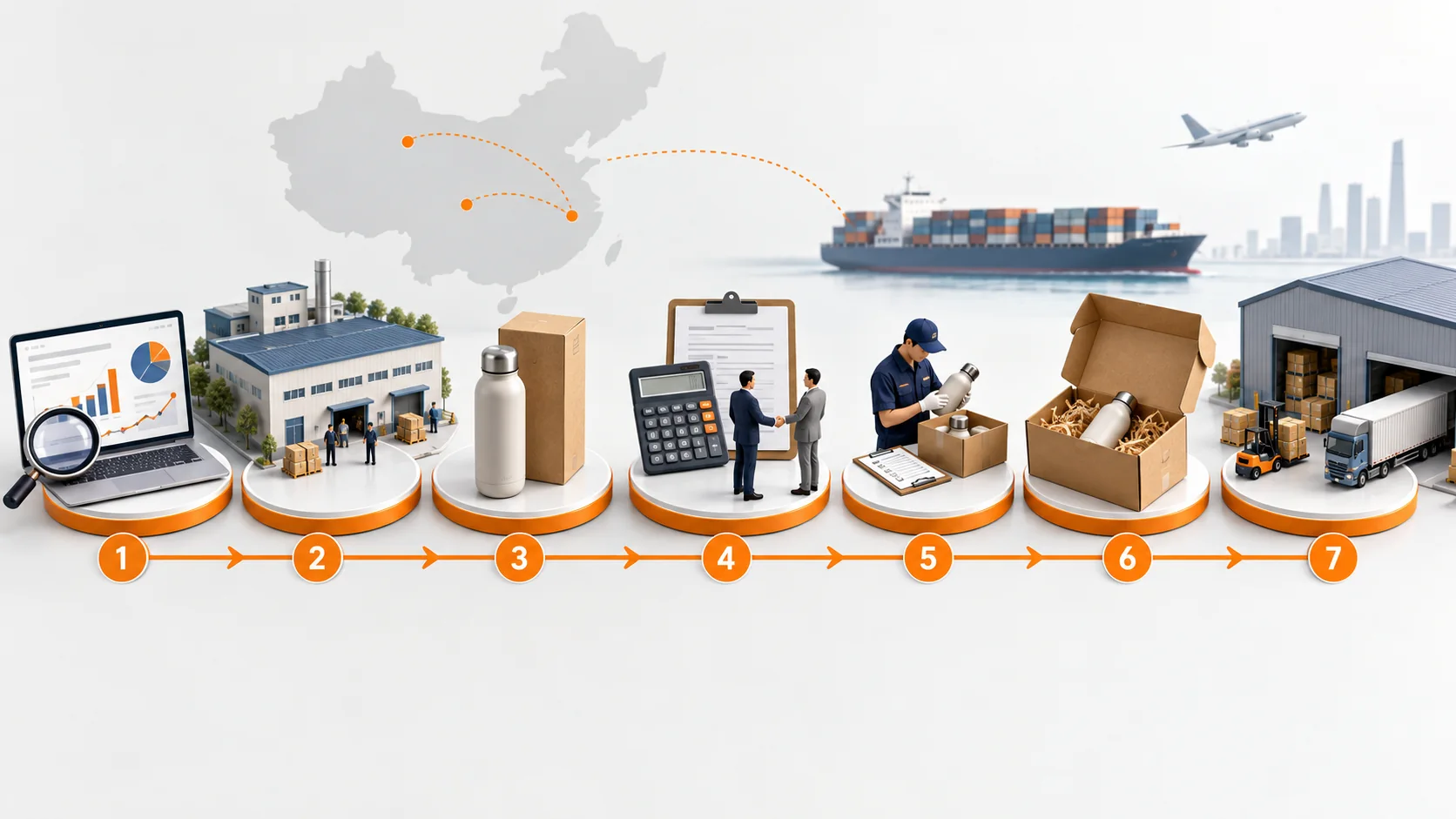
How to Launch Private Label Products in 7 Steps
Step 1: Pick a product with demand you can verify
Start from search and marketplace data, not from what you’d personally buy. Check Amazon best-seller ranks, search volume, and (this is the step people skip) how many of the top listings are already established brands with thousands of reviews. High demand plus weak incumbent brands is the pocket you’re looking for.
What goes wrong: sellers chase saturated categories because volume looks exciting. Phone cases and yoga leggings have demand; they also have hundreds of competitors sourcing from the same factories at better prices than you’ll get. Volume without an opening isn’t an opportunity.
Step 2: Find the factory — and confirm it’s a factory
Alibaba is fine as a directory. The problem is that roughly half the “manufacturers” on it are trading companies reselling factory output with a margin stacked on top. A trading company isn’t always bad, but you should know which one you’re talking to, because it changes your price, your ability to customize the product, and who’s accountable when a batch fails.
Ways to check: ask for the business license and match the registered name to the company you’re negotiating with. Ask for factory floor video on a live call. Compare their quoted spec sheet to two competitors: a reseller usually can’t answer process questions a production manager answers instantly.
Or skip the detective work and use a China sourcing agent who already holds factory relationships in your category. For one supply-chain overhaul we ran, factory-direct renegotiation cut a client’s sourcing costs 18% in 90 days. The margin was going to middlemen the client didn’t know existed. We keep a longer breakdown of vetting channels in our guide to finding a manufacturer in China.
What goes wrong: paying a 15–30% invisible markup for years. The client in that 18% case had been ordering through the same “factory” contact since 2022. It was a reseller.
Step 3: Sample before you commit to anything
Order samples from your top two or four candidates. Pay for them; free samples come out of someone’s showroom, not the production line that will run your order. When samples arrive, test them the way a customer would: wash the fabric, drop the box on concrete, leave the electronics charging overnight, run the zipper a hundred times.
At the testing stage speed matters more than perfection. This is why we built an instant quoting tool: upload a product photo, get 1/2/3-piece pricing back in seconds instead of waiting two days for a sales rep to email you back. If you’re comparing product ideas, get a quote on each before you fall in love with one.
What goes wrong: approving a “golden sample” and never referencing it again. Your sample is a contract exhibit. Photograph it, spec it in writing, and state in the PO that the batch must match it.
Step 4: Negotiate MOQ — but really, negotiate cash exposure
Factories quote MOQs of 500–1,000 units for most consumer goods. The number is more flexible than it looks; what a factory actually protects is their production-line changeover cost. You can often halve an MOQ by accepting a slightly higher unit price, which is nearly always the right trade for a first order.
Think in cash exposure, not unit price. A 1,000-unit order at $4 with 30% deposit ties up different money than 500 units at $4.60. We’ve watched brands with data-backed inventory models cut planned stock spending from $1M to $600K on the same revenue. At launch scale the same logic says: buy the smallest batch that lets you test real demand.
What goes wrong: emptying the account on PO #1, then stocking out during your first demand spike with no cash to reorder. A stockout three weeks after a successful launch is the most expensive kind of success.
Step 5: Inspect before the goods leave China
Pre-shipment inspection costs $150–300 and checks a statistical sample of your batch against the golden sample: function, cosmetics, labeling, packaging. It happens at the factory, before you pay the balance, and that timing is your entire negotiating position. Once goods are on the water and paid for, a defect rate is your problem; before balance payment, it’s the factory’s.
We run this as a standard step through our quality control service, and it’s the one step we won’t let clients skip even when the factory relationship is years old. Production lines drift. Material substitutions happen quietly in month eight, not month one.
What goes wrong: skipping inspection on reorder #5 because the first four were clean. That’s precisely when substitution shows up.
Step 6: Brand the unboxing, not just the logo
Private label margin lives in brand perception, and perception is mostly packaging. A logo on a poly bag is technically private label. It converts like a commodity.
The concrete version: we ran a 45-day brand upgrade for one client (custom boxes, insert cards, gift cards, custom mailer bags) and average order value rose 22%. Not from a product change. From the box. Gift cards in particular pull repeat purchases at near-zero marginal cost, and almost nobody in the testing stage bothers with them.
What goes wrong: ordering packaging after the product batch. Packaging has its own MOQ and its own lead time; misalign them and your inventory sits in a warehouse for three weeks waiting for boxes.
Step 7: Set up fulfillment before inventory lands
Decide where the goods go before they ship: a US 3PL warehouse, FBA, or a China-based warehouse shipping direct. Each has a different cost curve. Bulk-shipping to a US warehouse wins on per-order cost at volume; direct-from-China wins on inventory risk while you’re still testing; FBA wins on Prime badges and takes a fee stack in exchange.
If you’re selling private label products on Amazon, factor prep requirements (labeling, poly-bagging, carton specs) into your factory instructions — it’s far cheaper to have the factory prep FBA-compliant cartons than to pay for re-prep in the US.
What goes wrong: goods arrive at a port with no receiving appointment, no carton labels, and no warehouse contracted. Storage-in-limbo fees eat the margin the sourcing work just built.
Private Label Product Categories Worth a Look in 2026
Where we’re seeing testing-stage traction across client launches, with search demand behind it:
| Category | Why now |
|---|---|
| Herbal and wellness products | Steady demand, low difficulty; private label herbal products search interest keeps growing while big brands stay generic |
| Skincare | High margin, packaging-driven; pairs with the branded dropshipping model for low-MOQ testing |
| Coffee | Subscription-friendly, strong repeat rates; roasters offer private label at low MOQs |
| Wellness/recovery gear | The grounding-products niche below is one example of a spec-differentiated product in a commodity category |
Supplements deserve their own warning label: margins are real but so are FDA labeling rules and marketplace gating. We covered that in the private label supplement dropshipping guide.
A Launch From Zero: The Grounding Brand
A client came to us with a product idea in the sleep-wellness niche, grounding mattresses and yoga mats, with no factory relationship and no product spec. The full launch stack: we found the factory, ran product development iterations, coordinated influencer sourcing for the US launch, and set up the payment experience. The brand went from idea to selling DTC as a US wellness company, positioned around sleep quality.
The point isn’t that you need every one of those services. It’s that “private label” at the serious end stops being a product decision and becomes a supply chain: factory, spec, QC, packaging, fulfillment, and the marketing loop all have to connect. The brands that scale treat those as one system from day one.
Common Mistakes That Kill Private Label Brands
- Competing on price against the factory’s other customers. If your differentiation is a logo, the seller sourcing from the same line at 30% less wins.
- No written spec. “Same as sample” in a chat message is not a spec. Materials, dimensions, tolerances, packaging — in the PO.
- Ignoring landed cost. A $3.80 unit that ships air freight can cost more landed than a $4.60 unit moved by sea on a proper schedule.
- Scaling ad spend before supply can follow. Ads can 5x demand in a week. Factories cannot 5x output in a week. Ramp both on the same calendar.
FAQ
How much does it cost to start selling private label products?
For a real branded first run: $3,000–$10,000 covering product MOQ, samples, custom packaging, inspection, and freight. Testing-stage sellers can start lower via branded dropshipping, where an agent holds branded inventory and ships per order without a bulk buy.
Private label vs dropshipping — which should I start with?
Dropshipping tests demand with near-zero inventory risk but commodity margins. Private label owns the brand and the margin but ties up cash in stock. The common path we see work: validate demand with dropshipping or a tiny MOQ, then move winners to private label runs once a product proves 30+ orders a day.
How long does a private label launch take?
Sixty to ninety days is realistic: 1–2 weeks sourcing and sampling, 2–4 weeks production, 1 week inspection and export, 4–5 weeks sea freight, then receiving at the warehouse. Air freight compresses the freight leg to under a week if the margin supports it.