
FBA prep is the set of tasks that get your inventory ready to pass Amazon’s receiving rules before it lands in a fulfillment center. Labeling, poly bagging, bundling, carton counts, expiration dates. Get any of it wrong and Amazon either bills you to fix it or refuses the shipment at the dock. So FBA prep sits between your factory and Amazon’s warehouse, and it quietly decides whether your units go live in two days or sit stuck as “unfulfillable” for a week.
Most sellers learn this the hard way. First shipment gets flagged for a missing FNSKU or a poly bag with no suffocation warning, and a whole pallet goes dead while you scramble. This guide walks through what FBA prep covers, what it actually costs per unit, and when handing it to an amazon fba prep center beats doing it on your own kitchen table.
What Is FBA Prep?
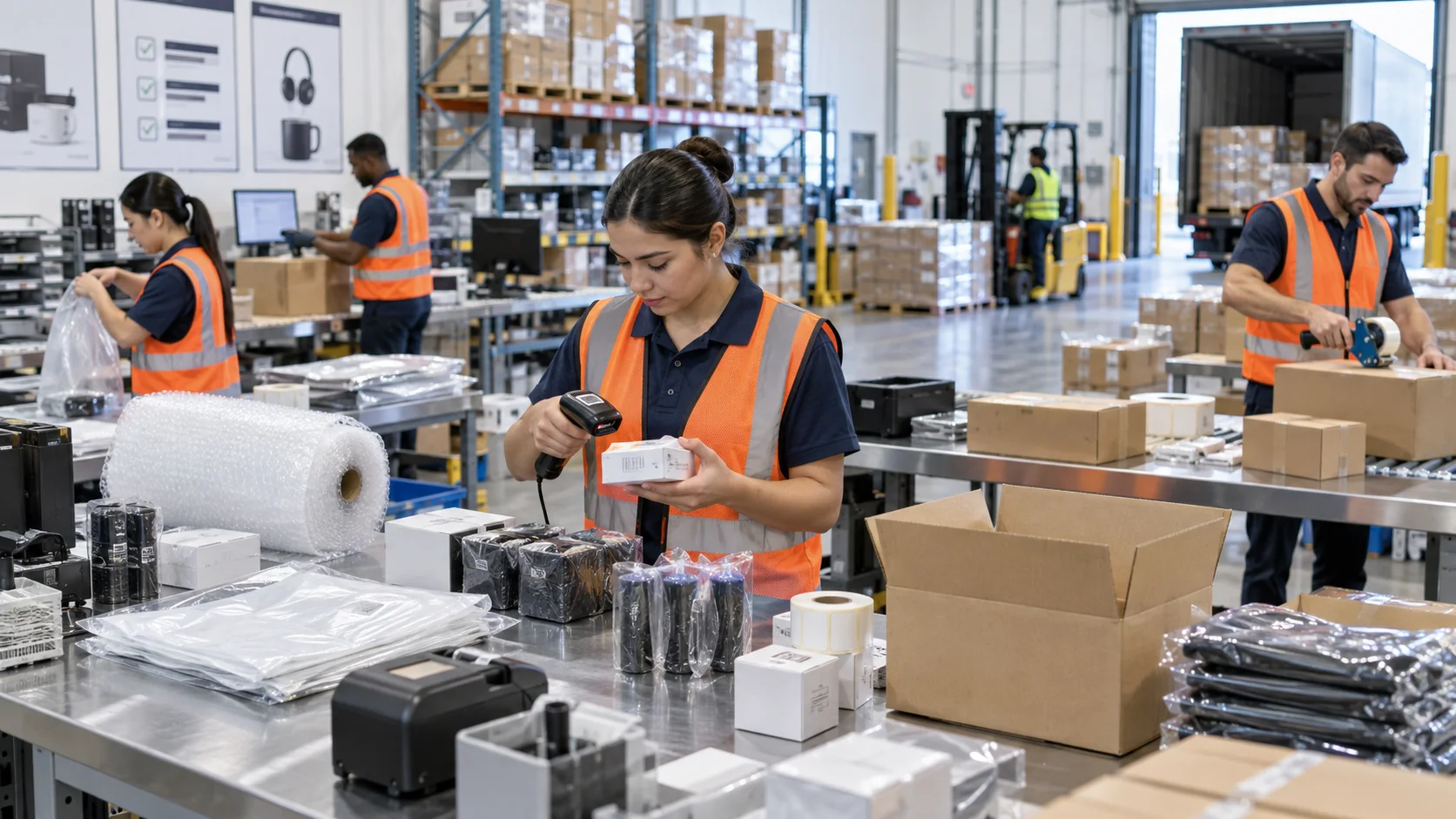
FBA prep is the physical preparation of products so they meet Amazon’s FBA packaging and labeling requirements. It covers FNSKU labeling, poly bagging, bubble wrapping, bundling, and boxing to Amazon’s carton specs. Done right, your inventory checks in clean — no deductions, no removals, no unfulfillable units.
Amazon assumes your goods arrive scan-ready. Their receiving staff won’t repackage a loose product or add a barcode for free. They’ll either apply their own paid prep service at a per-unit rate or bounce the shipment back to you. That’s why prep is a step you plan for, not a thing you react to after the fact.
What Does FBA Prep Include?
The exact checklist depends on the product, but most SKUs need some mix of these:
- FNSKU labeling. Every unit gets a unique Amazon barcode that covers the manufacturer barcode. This is the single most common reason shipments get flagged.
- Poly bagging. Bags over a certain size need a printed suffocation warning, and the bag has to be sealed with the barcode scannable through the plastic.
- Bubble wrap and fragile prep. Glass, ceramics, and anything with sharp edges needs protective wrap so it survives Amazon’s conveyor systems.
- Bundling and multipacks. A “3-pack” has to ship as one sealed unit with a single FNSKU, or Amazon will store and sell the three pieces separately.
- Expiration and lot labeling. Consumables, supplements, and topicals need dates in Amazon’s format, applied where their scanners expect them.
- Carton labeling and box content. Each master carton needs a shipment label plus accurate box-content data so receiving matches your plan.
We also fold in pre-shipment inspection on most orders, at roughly $150–300 per batch. It’s cheaper to catch a run of mislabeled units in the warehouse than to eat return-and-relabel fees after Amazon rejects the pallet. If you’re sourcing and prepping in one place, that inspection step catches factory defects before they ever get a barcode. You can see how prep folds into the wider workflow on our ecommerce fulfillment services page.
How Much Does FBA Prep Cost?
FBA prep is usually priced per unit, and the number moves with how much handling each SKU needs. A flat product that just needs an FNSKU sticker sits at the low end. A fragile item that needs bubble wrap, a poly bag, and bundling costs several times more per piece because someone’s hands touch it longer.
Rough ranges you’ll see across amazon fba prep center providers:
- Simple labeling: a few cents to around $0.50 per unit.
- Poly bagging or bubble wrap: $0.50–$1.50 per unit, depending on size.
- Bundling and multipacks: $1–$3+ per bundle, since it’s manual assembly.
- Pre-shipment inspection: $150–300 per batch, not per unit.
On top of prep, budget for receiving, short-term storage, and the outbound freight into Amazon. The trap sellers fall into is comparing only the sticker rate and forgetting that a cheap prep house with slow turnaround can cost you far more in lost sell-through. Because we run factory-direct sourcing with no finder fee, brands that source and prep with us skip a layer of middleman markup on the goods themselves, which changes the math more than shaving a penny off the label rate. Want a fast read on your own SKUs? Send product photos through our instant quote tool and you’ll get pricing back in minutes.
Can You Do FBA Prep Yourself?
Yes, and for a first small shipment you probably should — it teaches you exactly what Amazon checks. You buy the thermal printer, the poly bags, the labels, and you follow Amazon’s SKU-level prep guidance to the letter. It’s slow and finicky, but it’s real learning.
The trouble starts at scale. Once you’re moving a few hundred units a day, prep stops being a side task and becomes a job. Labels get applied crooked, suffocation warnings get missed on a rush, and a single rejected shipment wipes out whatever you saved doing it in-house. That’s the point where most sellers we talk to start pricing out a prep partner.
In-House vs. an Amazon FBA Prep Center
A dedicated prep center exists to do this all day, so their error rate and turnaround beat a founder working nights. They’ve already got the printers, the bagging stations, and the Amazon carton templates dialed in. They also absorb the seasonal spikes — Q4 volume doesn’t force you to hire and train temp staff.
The tradeoff is control and cost per unit. In-house means you touch every SKU and pay only for materials. A prep center adds a per-unit fee but hands you back the hours. The honest cutoff: if prep is eating time you’d rather spend on product and ads, or if a bad shipment would genuinely hurt cash flow, outsource it. If you’re still at a handful of units a week, keep it in-house a little longer. For US-bound volume specifically, our California FBA prep center puts prep close to the West Coast ports and Amazon’s western FCs.
How an FBA Prep 3PL Actually Works
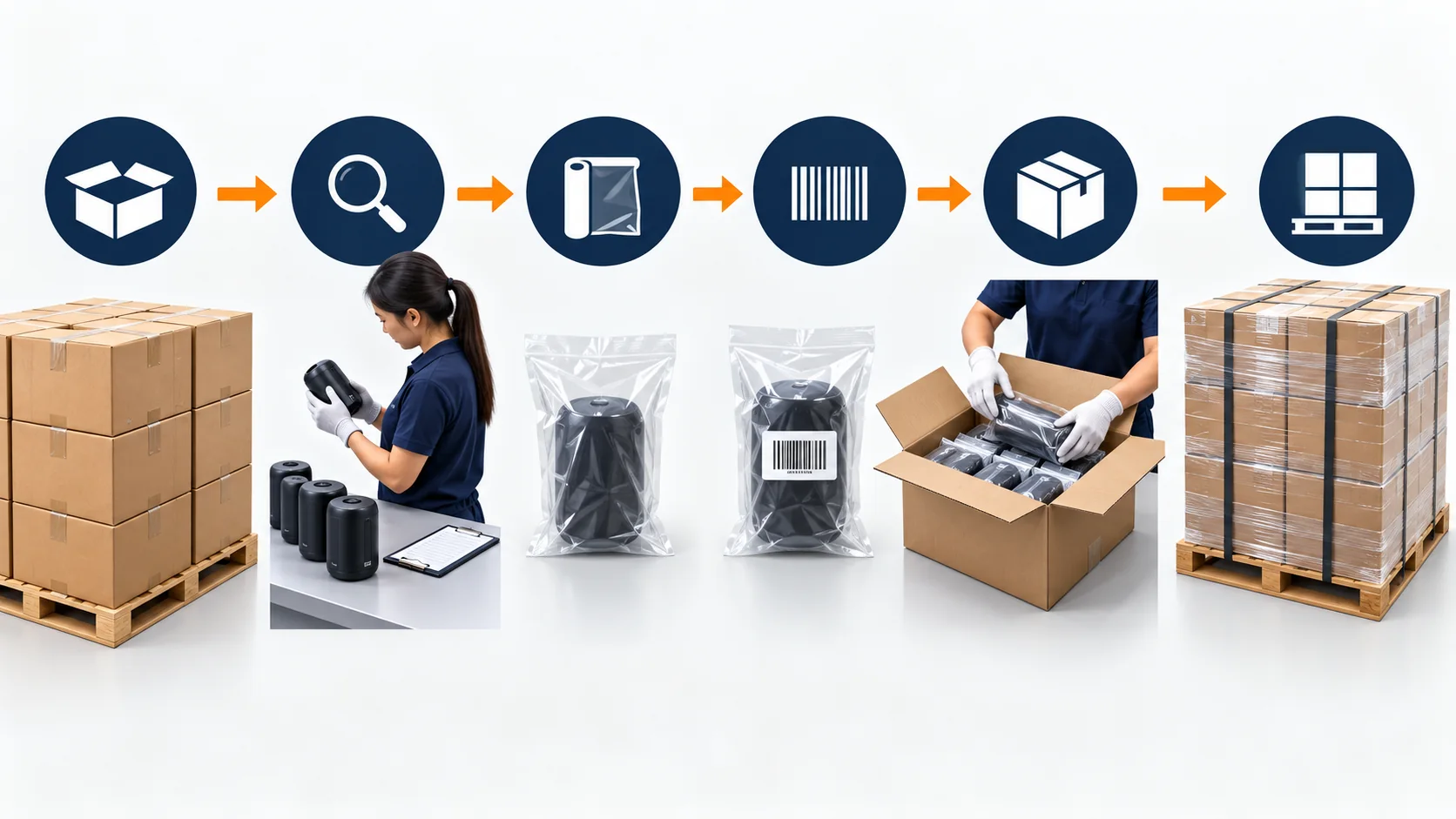
An fba prep 3pl takes your goods in, gets them Amazon-ready, and ships them into the FC network — while giving you inventory visibility the whole way. Here’s the normal flow:
- Inbound and receiving. Your factory or supplier ships to the 3PL’s warehouse. Staff count, log, and reconcile against your PO so you know exactly what arrived.
- Inspection. We check for defects and quantity accuracy before anything gets a barcode, so problems get caught while they’re still fixable.
- Prep and labeling. Each SKU runs through its prep spec — FNSKU, bagging, bundling, whatever that product needs.
- Boxing and shipment creation. Units get packed to Amazon carton limits, box-content data gets built, and shipment labels go on.
- Outbound to Amazon. Cartons ship into the assigned FCs on a schedule that keeps your inventory level healthy without over-committing stock.
Where a China-backed 3PL changes the picture is geography. We run warehouses across China, the US, and Europe, which means prep can happen close to the factory before goods ever cross an ocean, or close to the marketplace for fast top-ups. For orders already sitting in an overseas warehouse, local dispatch runs 24 hours plus 2–3 days last mile; cross-border direct shipping runs longer, in the 5–10 day range. Knowing which lever you’re pulling keeps your restock timing sane.
We serve everyone from DTC and Shopify sellers doing 200+ orders a day up to brands running $70M a year, and the prep logic scales the same way — flexible MOQs on the sourcing side and flexible payment terms so a big prep-and-restock cycle doesn’t strangle your cash. You can bundle prep with full fulfillment through our ecommerce fulfillment service if you also sell off your own store.
FAQ
Does Amazon offer its own FBA prep service?
Yes. Amazon will prep eligible units for you at a published per-unit fee when your shipment arrives unprepped or non-compliant. It’s convenient but rarely the cheapest option, and you lose the inspection step that catches defects before they’re barcoded. Most sellers past the beginner stage use a third-party prep center instead.
What’s the difference between an FBA prep center and a 3PL?
A pure prep center only gets goods Amazon-ready. A full fba prep 3pl does prep plus receiving, storage, inventory management, and often direct-to-consumer fulfillment for your own store. If you sell on Amazon and elsewhere, a 3PL keeps everything under one roof instead of splitting inventory across vendors.
How long does FBA prep take?
At a well-run prep center, turnaround is usually 1–3 business days from receiving to outbound, depending on volume and SKU complexity. The slow part is almost never the prep itself. It’s inbound freight and Amazon’s own receiving queue, so plan your restock dates around those, not around the prep step.