

Order fulfillment for ecommerce is the process of receiving online orders, picking products, packing shipments, sending them to customers, and handling returns. In 2026, the brands that win at fulfillment aren’t the ones with the prettiest warehouse tour; they’re the ones that ship accurately by 5 p.m., control DIM weight, keep inventory clean across channels, and turn returns into usable stock fast.
Order Fulfillment Basics
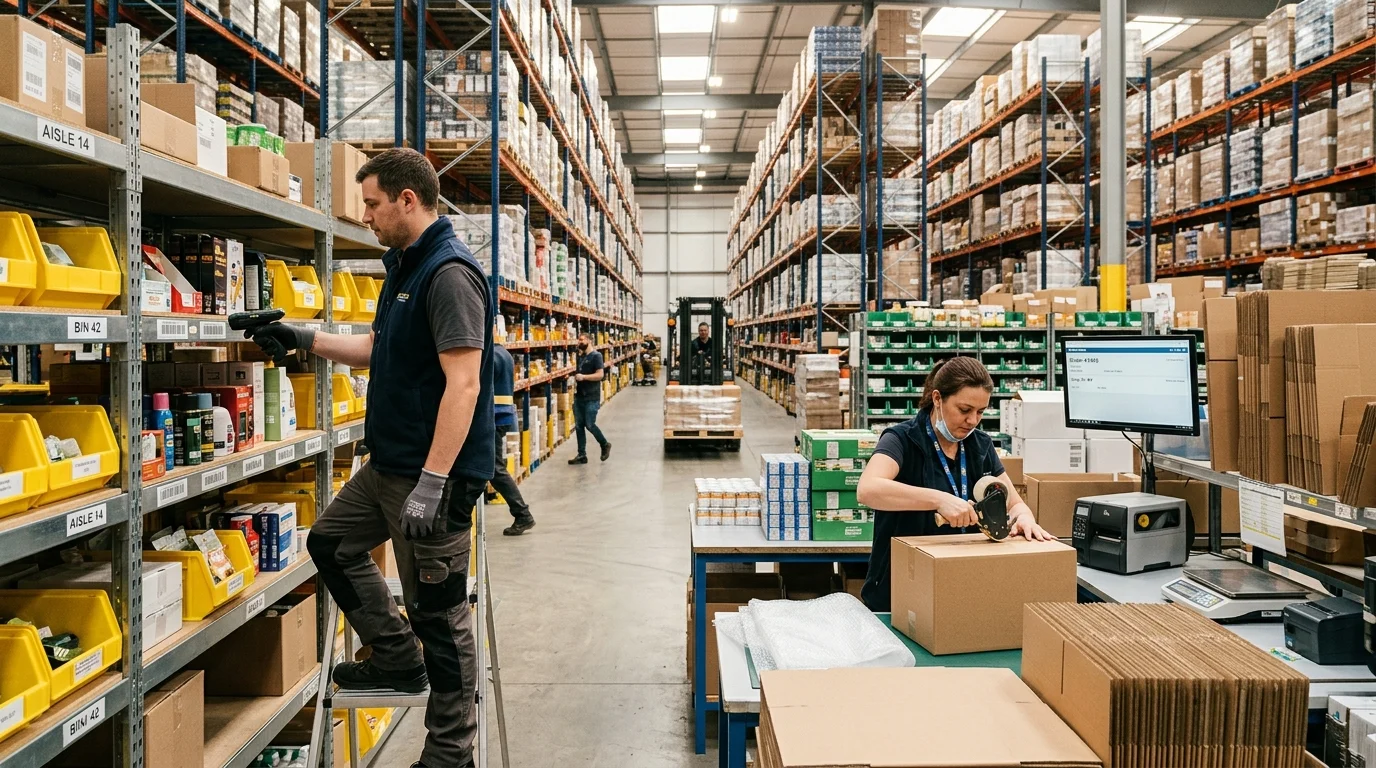
Order fulfillment for ecommerce is the operating system behind every online purchase: inventory is received, stored, sold, picked, packed, shipped, tracked, and returned when needed. A strong setup matches warehouse work to sales-channel promises, so a buyer in Chicago, Berlin, or Singapore gets the right item without excuses.
Why does this deserve board-level attention now? Because ecommerce volume is too large for casual warehouse habits. The U.S. Census Bureau reported that U.S. retail e-commerce sales reached $1.2337 trillion in 2025, up 5.4% from 2024, and accounted for 16.4% of total retail sales. When that order volume grows, a small miss rate becomes real money: wrong picks, refund tickets, carrier corrections, and dead stock.
A founder can pack 40 orders from a garage. A team can push 120 orders a day with shelves, scanners, and discipline. At 200+ daily orders, manual work starts breaking in strange places. The issue usually isn’t one big disaster. It’s 17 tiny delays: a purchase order received late, a Shopify SKU mapped wrong, a box size chosen by habit, a return left ungraded for nine days.
| Fulfillment step | Practical meaning | Common failure | 2026 fix |
|---|---|---|---|
| Receiving | Inventory arrives and gets counted | Purchase order and physical count don’t match | Barcode scan at carton and unit level |
| Putaway | Stock moves into bin locations | Popular SKUs sit too far from pack stations | Slot fast movers near the pick path |
| Picking | Staff pull ordered items | Similar SKUs get mixed | Use scan-to-pick rules |
| Packing | Items go into cartons or mailers | Oversized boxes trigger higher shipping cost | Set carton logic by SKU size |
| Shipping | Labels are bought and carrier scans occur | Orders miss carrier cutoff | Lock daily cutoff by warehouse zone |
| Returns | Items come back for inspection | Sellable stock sits in limbo | Grade returns within 48 hours |
Fulfillment also sets customer expectations before the first delivery. If your product page says “ships in 24 hours,” your warehouse needs inventory accuracy, labor coverage, and carrier pickup times to match. Marketing can’t outrun operations for long.
If you’re building a 2026 fulfillment plan, compare your order profile against FlexFulfills ecommerce fulfillment services before you sign a warehouse lease or lock into a rigid 3PL contract. The right answer depends on SKU count, order density, packaging needs, and where your buyers live.
Ecommerce Fulfillment Workflow
A customer buys a skincare bundle at 11:42 a.m. in Los Angeles. By 11:43, your system should know the sales channel, SKU, warehouse, stock level, payment status, fraud status, shipping service, and promised delivery window. If one of those fields is wrong, the order can still ship. It just ships badly.
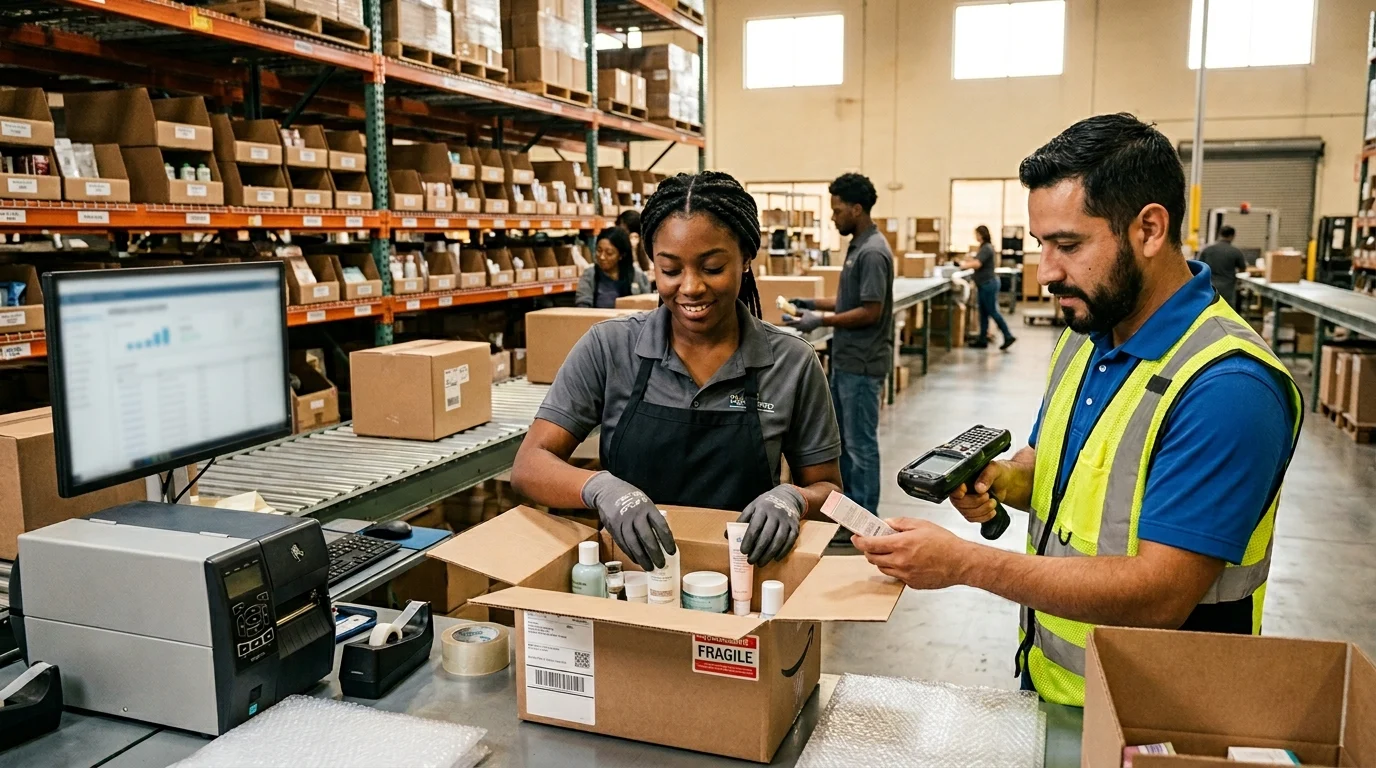
Most ecommerce fulfillment workflows follow this order:
1. The order enters from Shopify, Amazon, WooCommerce, TikTok Shop, BigCommerce, or a marketplace feed.
2. The warehouse management system checks available inventory and assigns a fulfillment location.
3. The order is released for picking, often by batch, wave, zone, or single-order pick.
4. The picker scans the bin and item barcode to reduce errors.
5. The packer selects packaging, inserts any brand materials, weighs the parcel, and prints the label.
6. The carrier collects the parcel, sends tracking, and updates the customer-facing order status.
The workflow sounds clean on paper. In real warehouses, the trouble starts with exceptions. A two-item order has one unit in stock and one unit in a receiving dock. A customer enters an address that USPS can read but DHL can’t. A marketplace order must ship today or your seller score drops. A VIP wholesale order gets mixed into direct-to-consumer batches and misses the truck.
For brands above 200 daily orders, batch design matters more than raw speed. Single-order picking works for low volume and fragile kits. Batch picking works better for high-volume SKUs like phone cases, supplements, apparel basics, or beauty tools. Zone picking wins when your warehouse has thousands of SKUs spread across aisles, but it needs clean handoffs. Bad handoffs create mystery delays.
The best workflow is boring in the right places. Orders enter automatically. Exceptions get flagged. Pickers scan. Packers don’t guess. Tracking pushes back to the store without someone refreshing a portal.
Fulfillment Cost Drivers
The cheapest fulfillment quote can become the most expensive option by week four. A $1.75 pick-and-pack fee looks great until you add storage minimums, carton charges, address corrections, marketplace prep, long-zone shipping, and return handling. Read the invoice, not the sales deck.

The largest cost driver is usually parcel shipping. A lightweight hoodie in a poly mailer may ship cheaply across the United States. A yoga mat, desk lamp, or insulated bottle can get billed by dimensional weight because the parcel takes up space even when it doesn’t weigh much. A 12 x 10 x 8 inch box is 960 cubic inches. At a 139 divisor, that rates as 7 pounds before zone, fuel, and residential surcharges enter the invoice.
| Cost line | What triggers it | Better default | Watch-out |
|---|---|---|---|
| Storage | Pallets, bins, cubic feet, or shelf space | Keep 60 to 90 days of stock for steady SKUs | Slow movers quietly eat margin |
| Pick and pack | Items picked and orders packed | Separate single-SKU and multi-SKU pricing | Bundle logic can change the fee |
| Packaging | Mailers, boxes, tape, inserts | Pre-set carton rules for top SKUs | Pretty boxes can raise DIM weight |
| Parcel shipping | Zone, weight, service, destination | Rate shop USPS, UPS, FedEx, DHL, and regional carriers | Faster service isn’t always better |
| Returns | Label, receiving, inspection, restock | Grade by sellable, repairable, dispose | Vague policies create support tickets |
Storage needs blunt math. If you sell 300 units a day and your factory lead time is 35 days, you can’t operate with 2,000 units unless you enjoy emergency air freight. If you sell 12 units a month of a bulky seasonal SKU, you shouldn’t store a full pallet in a premium metro warehouse.
Packaging deserves its own review because it links brand feel to shipping cost. A rigid gift box can make sense for a $180 serum set. It makes less sense for a $22 phone accessory where the box raises billable weight and offers no return in conversion. Use premium packaging where the customer notices it, then keep ordinary orders tight and protective.
3PL Fulfillment Decisions
For most brands consistently shipping 200+ direct-to-consumer orders a day, a capable 3PL beats a founder-run warehouse. The reason isn’t glamour. It’s hiring, carrier management, warehouse software, weekend coverage, return grading, and the fact that your leadership team should be working on product, cash flow, and channel growth.

In-house fulfillment still wins in specific cases. If you sell 30 custom furniture pieces a week, own specialized assembly steps, or need founder-level quality checks on every unit, outsourcing too early can hurt. If your products are regulated, temperature-sensitive, serialized, or high-theft, you need tighter controls before you move anything. Don’t let a low storage quote decide a high-risk operation.
A 3PL fit looks like this:
- Your daily order volume is too high for a small internal team but too variable for full warehouse staffing.
- Your SKU catalog is clear enough to barcode, bin, and count without tribal knowledge.
- Your customers are spread across the United States, Europe, Canada, Australia, and other major markets.
- Your team needs better carrier options, faster onboarding for sales channels, or cleaner return handling.
The uncomfortable part: outsourcing doesn’t remove accountability. You still own forecast accuracy, clean SKU data, packaging decisions, and customer promises. A 3PL can execute fast, but it can’t fix a product page that promises “2-day delivery” to every country on earth with no cutoff time.
Ask direct questions before signing. What happens when Amazon orders conflict with Shopify orders? How are partial receipts handled? What scan events prove an order was picked correctly? Who pays for a mispick? How fast are returns graded? Can the 3PL support branded inserts without slowing the line?
FlexFulfills looks at those details before quoting because order fulfillment for ecommerce depends on the operating pattern, not just the order count. A 900-SKU apparel brand with size exchanges needs a different setup from a 40-SKU supplement brand with subscriptions.
Global Shipping Controls
International fulfillment punishes vague setup. A domestic order can survive a clumsy description like “blue bottle.” A cross-border order needs product descriptions, HS codes, declared value, country of origin, battery status, tax treatment, and carrier service rules. Customs doesn’t care that your launch week is busy.
The first decision is delivery duty paid or delivery duty unpaid. Delivery duty paid means the buyer pays duties and taxes at checkout, then receives the parcel without a surprise bill. Delivery duty unpaid can look cheaper at checkout, but it often creates refused packages, angry emails, and stuck inventory. For brands selling into the United Kingdom, Germany, Canada, Singapore, and the Gulf states, delivery duty paid usually works better for customer trust.
| Control | Owner | Proof to keep | Failure mode |
|---|---|---|---|
| HS code | Operations or trade advisor | SKU-level classification file | Customs delay or reclassification |
| Country of origin | Supply chain team | Factory and purchase records | Incorrect duty treatment |
| Declared value | Finance and ecommerce team | Invoice and checkout record | Underpayment or seizure risk |
| Restricted goods | Compliance owner | Carrier and market rule checks | Parcel rejected before export |
| Delivery terms | Ecommerce manager | Checkout duty setting | Customer refuses delivery |
This advice doesn’t apply cleanly to every product. Cosmetics, supplements, food, medical devices, alcohol, and lithium battery items need category-specific checks before you promise global delivery. If your catalog includes power banks or devices with installed batteries, have your operations team review IATA Dangerous Goods Regulations and carrier rules before air shipment. Guessing here is expensive.
For global brands, fulfillment location also changes margin. Shipping every European order from California may work for a new brand testing demand. Once Germany, France, the Netherlands, and the United Kingdom become repeat markets, you need to compare landed cost, transit time, return path, and tax setup. A second fulfillment node can help, but only when inventory split doesn’t create stockouts in both places.
Returns Planning
Returns are part of fulfillment, not an afterthought for customer support. The National Retail Federation and Happy Returns reported that U.S. retail returns were projected to reach $890 billion in 2024, with retailers estimating 16.9% of annual sales would be returned. They also found 76% of consumers consider free returns a factor in where they shop.
That doesn’t mean every brand should offer free returns on everything. A $28 accessory with $6.50 outbound shipping and $5.80 return postage can’t absorb unlimited free returns unless the margin is unusually strong. Apparel brands may accept higher returns because size confidence drives conversion. A supplement brand may restrict opened products. A furniture brand may require photos before approval because freight returns can destroy margin.
A good return flow has four decisions:
1. Who pays for the label?
2. Which returns need approval before shipping back?
3. How are items graded after receipt?
4. When does the refund trigger?
The refund timing question matters more than teams expect. Instant refunds improve customer trust, but they increase fraud exposure. Refund after warehouse receipt protects cash, but it can annoy honest buyers. For high-AOV goods, refund after inspection is usually better. For low-risk repeat customers, faster refunds can protect loyalty.
Return grading should be specific. “Returned” isn’t a useful inventory status. Use sellable, damaged, missing parts, needs cleaning, quarantine, donate, or dispose. If your 3PL can’t show those states in reporting, you’ll end up with a warehouse corner full of mystery cartons and a finance team asking why available stock doesn’t match the balance sheet.
FAQ
What is ecommerce order fulfillment?
Ecommerce order fulfillment is the work that happens after an online order is placed: receiving inventory, storing it, picking products, packing parcels, shipping orders, sending tracking, and processing returns. For growing brands, the goal is accurate delivery at a cost that still protects margin.
How much does fulfillment cost?
Fulfillment cost depends on storage, pick-and-pack fees, packaging, parcel shipping, returns, and special handling. For most ecommerce brands, parcel shipping is the largest variable cost, while poor inventory accuracy creates the most hidden cost through stockouts, split shipments, and support tickets.
When should brands outsource fulfillment?
Brands should consider a 3PL when daily order volume passes 100 to 200 orders, internal staff can’t keep up, carrier costs rise, or returns take too long to process. Keep fulfillment in-house longer if products need custom assembly, strict inspection, or unusual compliance controls.
Which fulfillment KPIs matter?
Track order accuracy, same-day ship rate, inventory accuracy, cost per order, average transit time, return cycle time, and damage rate. A brand can survive a slightly higher fulfillment fee if accuracy and transit times improve enough to reduce refunds, reships, and support workload.
How do ecommerce returns work?
Ecommerce returns usually start with a return request, label creation, inbound shipment, warehouse inspection, item grading, restocking or disposal, and refund approval. The policy should match product economics: apparel, electronics, supplements, and oversized goods each need different return rules.
Before you choose a 2026 fulfillment setup, pull a 30-day order export, your full SKU list, top 10 destination countries, average carton sizes, and return reasons. FlexFulfills can use that data to map a practical order fulfillment for ecommerce plan through global 3PL fulfillment support, with fewer guesses and cleaner handoffs.