

Ecommerce kitting fulfillment can happen before an order arrives or after a customer places it. Pre-kitting moves work into an advance batch and leaves finished sets ready to pick; building to order keeps components available for other uses but adds work to each shipment. The better choice depends on demand, component availability, packing capacity, and the full cost of your particular kit.
Start with a real bundle and compare both methods using the same order forecast and warehouse quote. Then test one sample before committing inventory to a large run.
Choose When to Assemble
Pre-kit when a fixed set has sufficiently predictable demand, you have space for finished units, and a batch can be built before orders peak. Build to order when the contents change often or components also sell individually. A hybrid approach can protect a modest batch for expected demand while leaving the remaining components flexible.
| Decision | Pre-kit | Build to order |
|---|---|---|
| When work happens | In a batch before orders | After an eligible order arrives |
| Stock held | Finished kits plus remaining loose components | Separate components and packaging |
| Order-time task | Pick the completed kit; add any order-specific outer packaging | Pick each component and assemble the kit |
| Tradeoff | Less order-time assembly, but components are committed | More flexibility, but each order needs assembly capacity |
| When the offer changes | Unsold sets may need rework or disassembly | Update the instructions and component mapping before release |
Neither method guarantees a lower bill. A finished kit can need its own storage space and a separate pick fee; an on-demand order may incur multiple component picks and an assembly fee. Ask the provider how each step appears on the invoice.
Compare Kitting for One Three-Item Set
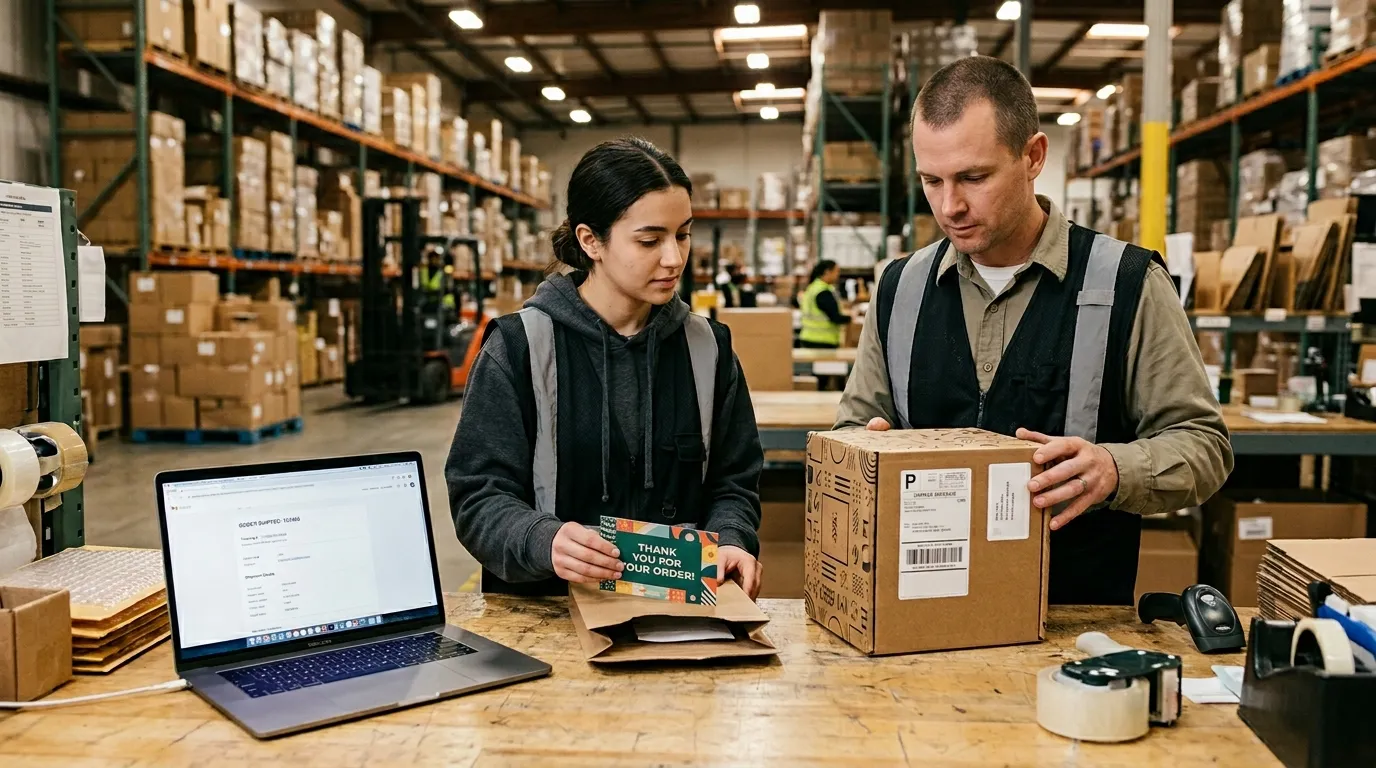
Consider an illustrative gift set containing one notebook, one pen, and one card in a branded box. The notebook and pen are also sold individually. The brand expects 400 set orders during a promotion, but the forecast is uncertain.
For a pre-kit run, the warehouse removes 400 notebooks, 400 pens, 400 cards, and 400 boxes from loose stock, assembles the sets, and records 400 finished units after the completed quantity passes inspection. Each customer order then consumes a finished set. If only 300 sell, 100 units remain in that configuration until sold, approved for rework, or dismantled.
For build to order, the warehouse retains each component separately. When a set order is accepted, it reserves the required components, picks them, follows the packing instructions, and records their consumption according to the system’s agreed rules. The remaining notebooks and pens can serve individual orders, subject to existing reservations.
A mixed plan is also possible: build an initial 200 sets, keep the other components loose, and review the remaining forecast after launch. That quantity is an example, not a universal target. Confirm the point at which the warehouse can switch between finished-kit stock and loose components without allocating the same unit twice.
Calculate the Complete Kitting Fulfillment Cost
Compare ecommerce kitting fulfillment costs over the same period and expected number of shipped orders. Include the setup and approved sample, assembly, packaging, picks, finished-kit or component storage, transportation, and any expected rework. Exclude a line only when it is already included in another quoted fee.
| Illustrative cost | Pre-kit: 400 built, 300 sold | Build to order: 300 sold |
|---|---|---|
| Setup | $120 | $40 |
| Assembly | 400 × $0.45 = $180 | 300 × $0.70 = $210 |
| Order-time picks | 300 × $0.25 = $75 | 300 × $0.50 = $150 |
| Storage and expected rework | $45 + $30 = $75 | $30 + $0 = $30 |
| Illustrative total | $450, or $1.50 per set shipped | $430, or about $1.43 per set shipped |
These are made-up planning inputs, not FlexFulfills prices or market averages. The comparison covers operational service fees only: product and packaging purchase costs are excluded from both columns. The pre-kit total includes assembly and estimated rework for 100 unsold sets, but does not value the components tied up in them or the remaining recoverable inventory. Model any nonrecoverable packaging for unsold sets separately, and add postage and taxes if they differ.
If all 400 sets sell, the pre-kit order-time pick cost becomes $100. With the same $120 setup, $180 assembly, $45 storage, and no $30 rework, the total is $445, or about $1.11 per shipment. Recalculate both scenarios using your own provider’s actual charges; the result can change with sell-through and storage time.
Define the Kit and Inventory
A bill of materials (BOM) tells the warehouse exactly what belongs in the set. It should identify the parent offer, each component SKU and quantity, packaging, insert version, label, assembly order, and the effective date of the specification. A photograph of the approved sample helps staff check presentation alongside the written instructions.
| Work-order field | Example instruction |
|---|---|
| Kit and version | GIFT-01, version 1; 400 planned units |
| Components | One NOTE-01, one PEN-01, one CARD-01 per kit |
| Packaging | One BOX-01; place pen beside notebook and card on top |
| Check | Confirm identifiers and quantities; compare first finished sample with approved image |
| Exception | Hold an incomplete kit and notify the named approver; no unapproved substitutions |
Keep internal SKUs distinct from retail identifiers. Before creating a barcode or listing a physical assortment, check the applicable identifier and marketplace requirements. GS1 US explains how GTINs identify trade items; the exact identifier decision depends on how the set is sold and packaged.
For pre-kitting, agree when the system deducts loose components and recognizes finished kits. For on-demand orders, agree when components are reserved, consumed, and released after cancellation. A kit’s buildable quantity depends on the limiting component, after accounting for existing reservations and safety stock. Our inventory system selection guide covers the broader system requirements.
Approve a Sample Run
Before a full batch or a live on-demand offer, test the ecommerce kitting fulfillment process using actual components, packaging, and the order data your warehouse will receive. Record the version tested and who approved it. Repeat the check when a component, supplier label, insert, or packaging instruction changes.
- Compare each delivered component and quantity with the work order; report shortages before assembly.
- Build one first sample, inspect its contents and presentation, and obtain written approval before a batch starts.
- Scan or otherwise verify the correct component and quantity at the agreed control point; separate incomplete kits.
- Test one complete kit order, one component sold separately, and one cancellation. Reconcile available and reserved quantities after each.
- Check how the warehouse labels, stores, and picks a finished kit, and how a customer-specific insert is added if required.
- Agree how damaged, unsold, or changed sets are opened, counted, and returned to suitable inventory statuses.
Ask for the sample approval, component consumption report, completed quantity, exception log, and an itemized invoice. If a scan or weight check is proposed, ask what errors it can and cannot detect; equal-weight components can make weight alone an unreliable proof of contents.
Manage Shortages and Changes
One missing card can stop a set even when the notebook and pen are plentiful. Decide whether that item is mandatory, whether a substitute is permitted, and who must approve a revised BOM. Hold affected orders until the decision is recorded; do not silently change the customer’s offer.
If finished kits must be opened, count what is recovered, separate damaged packaging, and record the cost of the extra handling. A change to a marketplace listing or sales promise may need its own approval. When multiple channels compete for components, define priority before the shortage; the order-priority guide explains how to document that decision.
FAQ
What Is Ecommerce Kitting Fulfillment?
It is the warehouse work of combining products and packaging into a customer-ready set, then fulfilling the order. Depending on the operating model, the set may be assembled in advance or after an order arrives.
Does a Kit Need Its Own SKU?
A distinct kit SKU helps identify a finished pre-built unit and the offer it fulfills. For an on-demand offer, agree how the sales listing maps to component SKUs and reservations; barcode requirements are a separate question.
Can a Brand Use Both Methods?
Yes. A business can pre-build a measured quantity of a stable set and assemble additional orders from loose parts, provided the warehouse and sales systems keep reservations and finished inventory separate.
What If a Kit Component Changes?
Pause affected work, approve a revised specification, and decide how to handle unfinished and completed stock. Check listing and identifier requirements before releasing the new version.
Put the Decision to Work
Choose one representative bundle and ask your warehouse to quote both workflows using the same forecast and work order. Review sell-through, cost per shipped set, exceptions, and remaining stock after the trial. FlexFulfills describes its ecommerce fulfillment service; confirm the kitting processes and system integrations needed for your specific product before launch.